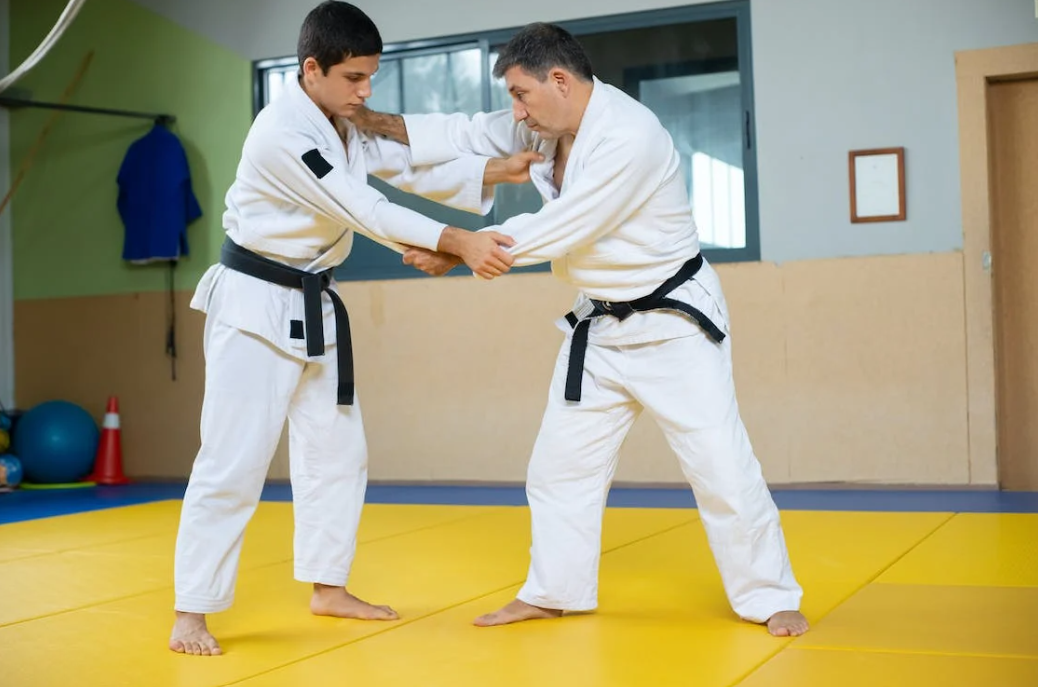
Judo is a modern martial art, sport, and form of physical exercise developed in Japan in 1882 by Jigoro Kano. It is a systematized form of jujitsu, taking its name from the Japanese words jū (柔, “gentleness”) and dō (道, “way”). Its most prominent feature is its competitive element, where the goal is to either throw (sutemi waza) or pin (osaekomi waza) an opponent to the ground, or to force an opponent to submit (juji-gatame, armlock; shime-waza, chokehold).
Judo is one of the most popular martial arts in the world, with more than 20 million practitioners. It is an Olympic sport, and is also used for self-defense, physical fitness, and sport.
History
The history of judo can be traced back to the 16th century, when jujitsu was introduced to Japan from China. Jujitsu is a system of unarmed combat that uses throws, locks, and chokes to subdue an opponent.
In the 19th century, jujitsu was in decline. It was seen as a brutal and ineffective form of self-defense. Jigoro Kano, a Japanese educator and philosopher, was determined to revive jujitsu and make it into a more practical and humane form of self-defense.
In 1882, Kano founded the Kodokan, the first judo dojo. He began by studying the various styles of jujitsu, and then he began to develop his own system. Kano’s goal was to create a martial art that was both effective and safe. He wanted to create a system that could be used by people of all ages and sizes, and that would not cause serious injury.
Kano’s system was based on the principles of judo, which are:
- Seiryoku zen’yo, maximum efficiency with minimum effort
- Jita kyoei, mutual welfare and benefit
- Judo waza o katsuyo, the use of judo techniques for the benefit of society
Kano’s system was a success. Judo quickly became popular in Japan, and it soon spread to other parts of the world. Today, judo is an Olympic sport, and it is practiced by millions of people all over the globe.
Techniques
Judo techniques are divided into two categories:
- Nage-waza (投げ技), throwing techniques
- Katame-waza (固め技), grappling techniques
Nage-waza techniques are used to throw an opponent to the ground. There are many different types of nage-waza techniques, including:
- O-goshi (大腰), major hip throw
- Uki-goshi (浮腰), floating hip throw
- Seoi-nage (背負投), shoulder throw
- Kouchigari (小内刈), inner reap
- Harai-goshi (払腰), sweeping hip throw
Katame-waza techniques are used to pin an opponent to the ground. There are many different types of katame-waza techniques, including:
- Osaekomi-waza (押込技), pinning techniques
- Shime-waza (絞め技), choking techniques
- Kansetsu-waza (関節技), joint locks
Competition
Judo is a competitive sport. There are two main types of judo competitions:
- Randori (乱取り), free sparring
- Shiai (試合), competition
Randori is a form of free sparring that is used to practice judo techniques. Randori is an essential part of judo training, and it helps to develop the student’s skills and understanding of judo.
Shiai is a competitive judo match. Shiai matches are held under a set of rules, and the winner is the first person to score an ippon, waza-ari, or yuko.
Benefits
Judo has many benefits, including:
- Physical fitness
- Self-defense
- Discipline
- Respect
- Teamwork
- Confidence
- Mental focus
- Stress relief
- Social skills
Judo is a great way to improve your physical fitness, self-defense skills, and mental focus. It is also a great way to make new friends and learn about Japanese culture.
If you are interested in learning judo, there are many different schools and organizations that offer classes. You can find a judo school near you by searching online or asking your friends and family for recommendations.